In this post, I am going to briefly summarize where and/or how a Victim is involved in the process of criminal court followed by a reference to Victims Rights legislation that states . Please note, this blog is written from my own perspective as a woman who was sexually assaulted by a male.
Who Represents Who?
In Canada, victims of a sexual assault who find themselves along for the ride in the criminal justice system do not have a lawyer. The defense attorney represents the accused person. The crown attorney (aka: prosecutor) represents ‘the crown‘; a word that symbolizes the state and its government. In this case, the state and its government is Canada. The crown attorney therefore is responsible for representing and taking actions on behalf of all members of the public. The Judge (or Jury) hears both sides, the defense (representing the accused) and the crown (representing the public) to decide if there is sufficient evidence for a conviction.
The Politics of Evidence
This needing enough evidence is an important distinction. This means that if an accused person is acquitted (they receive a ‘not guilty’ verdict and are free to go), it is because there was not enough evidence to apply the full extent of the law. It DOES NOT mean that there was an absence of evidence because in fact, there WAS enough evidence for the person to be arrested, charged and a trial to be had (see here for a flow chart of the criminal process).
An acquittal therefore means that there was not enough evidence to meet the threshold (beyond a reasonable doubt) required for a person to be convicted. As such, an acquittal (not guilty) does not mean a person did not commit a crime (e.g. sexual assault). So the next time you hear someone making claims that because a person was found not guilty, it means they are innocent, please know THAT IS NOT A CORRECT ASSUMPTION. Not guilty is not the same thing as innocent. It just means that the crime was not ‘proven to happen’ in a court of law. In a court of law, the evidence that did exist was not considered to be strong enough to convict.
For anyone who understands sexual assault, the private nature of domestic violence and the accompanying shame that silences victims often leading to no collateral information or additional witnesses, how someone is found ‘not guilty’ is problematic. Additionally, stereotypes that introduce bias into the decision of the Judge or a Jury means that credible evidence/testimony provided by a victim/witness is ripped to pieces using illogical arguments based on rape culture and rape myths. The main goal of the defense lawyer is often to discredit the victim, in any way possible (a process referred to as whacking), so that the main source of evidence available (the victim) is portrayed as untrustworthy so that the defense can win a case. Winning is apparently more important than justice, dignity and respect. For the life of me, I can not understand how behaviour by a defense attorney that is done to deliberately skew how evidence is presented and interpreted is not regarded as unethical and a form of tampering with evidence. My official opinion? That is fucked up.
A Quick Note on Gender
Bias created by rape culture and rape myths in criminal courts has been discussed so far using my own gender-binary situation. That is, a female is sexually assaulted by a male. This does not mean that others do not experience sexual assault or that their story is less valid. Men also experience sexual assault. People who identify as LGBTQ2SAI+ experience sexualized, gender-based violence (e.g. sexual assault, hate crimes) at higher rates than gender binaries. This does not mean that rape culture does not apply to LGBTQ2SAI+ people. It means how rape culture LGBTQ2SAI+ people is not talked about as often and as such, is less understood. The fact that LGBTQ2SAI+ people experience sexual assault at higher levels than heterosexual or gender binary people is support for societal beliefs that certain groups of people are are viewed as targets or deserving of violence; the exact same mind-frame that informs rape culture.
Regardless of who is sexually assaulted, men commit 94% of sexual assaults. Even when men are being sexually assaulted, it is more likely that they are being violated by another man and not women or someone with a non-binary gender identity. This is a problem that requires more research, intervention and most of all, accountability and healing. People who abuse have most likely suffered themselves. People who abuse who then deny they abuse have a lot of work to do. Creative solutions that hold abusers accountable while also helping them work through denial and shame is needed to prevent repeat offenders, build safe communities and eradicate hate and punishment as acceptable under any circumstances.
What is the Role of the Victim Then?
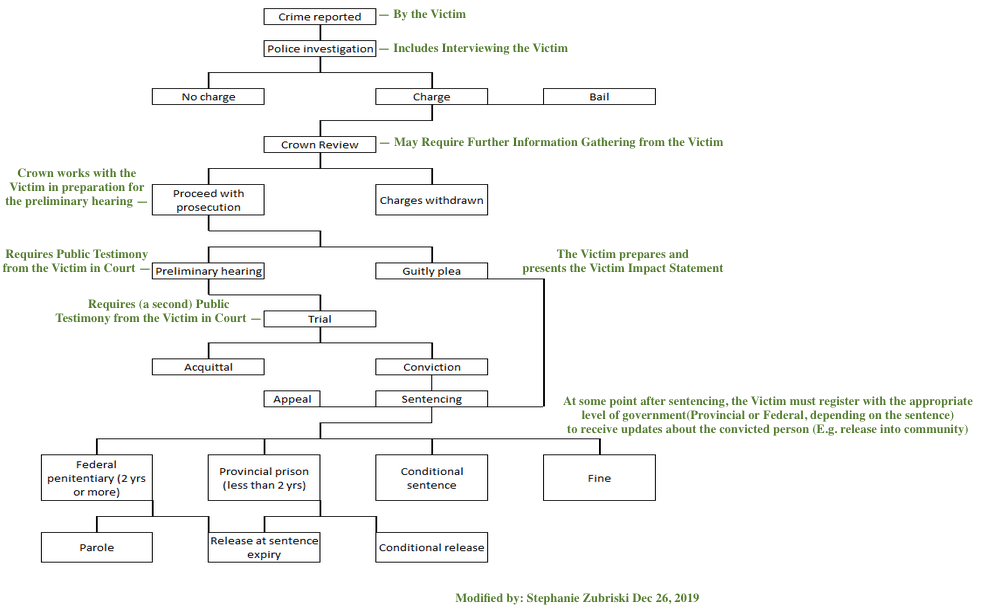
Notice that not even the flow chart provided by the Office of the Federal Ombudsman for Victims of Crime includes information about the role of the victim. It outlines the criminal process so that victims can “understand”. These boxes of steps are however, relatively meaningless. In what ways a victim can or is expected to participate remains elusive. In other words, there is no information about how each step impacts a victim. This omission of the role of victims and how the system impacts them, even by branches of Canada’s Federal Government that are meant to serve victims is one of the many reasons victims do not feel heard or as if they are denied information about the process itself.
I can testify that I have very much felt like a witness. Mined and drilled for information. But not the information that is important to me, how I was taken advantage of. No. They (police, crown, judge, jury) have their protocols. My story of how the sexual assault impacted me is fit into the Victim Impact Statement (VIS); usually a form that is ‘considered’ by the judge or jury at sentencing. Exactly how the VIS is considered and whether a VIS is considered to be or acknowledged as useful is not clear. Finally … the defense lawyer is entitled to a copy of the VIS and may cross-examine the victim (see the section: “Lessons for Counsel: Object now or forever hold your peace…”) on their statement. This means if the defense wants to ‘correct’ or challenge or use the information in a VIS to further attempt to discredit the victim, they may do so.
Whether in the court or to seek compensation for counseling, I am called upon to provide my testimony over and over and over again. Not only do I feel like a tool in the crown’s toolbox that is but one used to build a case, but there is an expectation for me to be vulnerable and also be completely fine with not having any choice about when or how I can be vulnerable. I feel that the authorities in this situation consider it to be my civic duty to provide my testimony in a court of law so that it can be decided if this person that manipulated, abused and sexually assaulted me should be punished. Not because of what they did to me but in order to prevent further risk to society. The crown represents the public remember, I am only one person. The Judge/Jury will decide if there is enough evidence to believe that the person who assaulted me actually did and is a ‘real’ risk to society. I have added to the flow chart provided by the Office of the Federal Ombudsman for Victims of Crime (in green) points where I, as a victim was expected to play some kind of a role.
Victims Bill of Rights
The Canadian Victims Bill of Rights outlines four main rights that a victim is entitled to throughout a criminal proceeding; information, participation, protection and restitution. The rights apply from the time that the initial report is made until the accused person is no longer being followed by the criminal justice system for the specific matter that impacts the victim.
I will say that I only became aware of the Victims Bill of Rights through my own research efforts to understand the system in general and to inform my writing of this blog about a month ago. That is, more than a year after I reported my sexual assault to the police, I stumbled across this piece of legislation that is meant to apply to me throughout the criminal justice process. Not even the representative of Ontario’s victim-witness assistance program that I am connected to informed me of my rights.
Stay tuned for another post that will delve deeper into how I have experienced these rights and how they have been (or have not been) applied to my situation. Right now, I am wondering how many times I could have quoted my rights when asking for information about this process. There have been times where I felt that the amount of work that I had to put in to get a clear answer about process or what I can expect was unnecessarily onerous and required me to jump through hoops. I can not help but wonder if some of the burden could have been lessened if I reminded the authority figure of their legal duty to provide me with information under the Victims Bill of Rights….
Until next time.

 ivan beck
Leave a comment